
RBI’s New Governance Rules: Why Manual Tracking Is Getting Risky for UCBs
Co-operative banks have seen a genuine wave of governance reforms over the past year, from the RBI, the government, and NABARD. Each one comes with its own rules, timelines, and record-keeping requirements. Here’s exactly what’s changed, backed by the actual notifications.
The Governance Changes, One by One
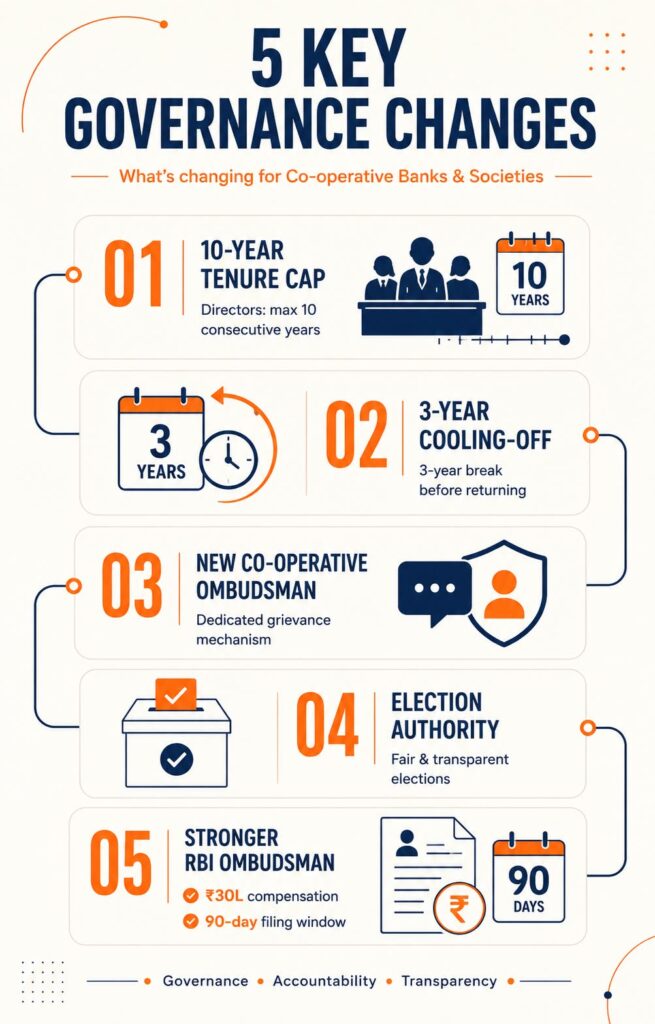
- Director tenure caps. The Banking Regulation Act now limits Co-operative bank board members, excluding the chairperson and whole-time directors, to a maximum of 10 consecutive years.
- The cooling-off loophole, closed. On May 25, 2026, the RBI issued Amendment Directions requiring a mandatory 3-year cooling-off period after that 10-year mark. This targets a pattern regulators noticed: directors briefly resigning and getting re-elected to extend their stay. Under the new rule, any break shorter than 3 years no longer resets the tenure clock, only a full 3-year gap does.
- A new Co-operative Ombudsman. The Multi-State Co-operative Societies Act has been amended to create a dedicated Ombudsman handling complaints about deposits, member benefits, and equitable treatment.
- A Co-operative Election Authority. This new body now oversees free and fair elections across multi-state Co-operative societies, an area regulators wanted more structure around.
- A tougher RBI Ombudsman Scheme. The Reserve Bank–Integrated Ombudsman Scheme, 2026 came into force on July 1, 2026, covering UCBs with deposits of ₹50 crore or more, along with State and Central Co-operative Banks. It raised compensation limits from ₹20 lakh to ₹30 lakh, and shortened the complaint filing window from one year down to 90 days.
What These Rules Actually Require
None of these rules technically demand digital systems. A bank could, in principle, track everything manually, tenure dates, election records, complaint timelines, on paper or in spreadsheets.
But taken together, they ask for quite a bit of ongoing precision:
| Requirement | What It Demands |
|---|---|
| 10-year tenure cap | Continuous tracking per director, across years |
| 3-year cooling-off rule | Correctly calculating gaps, not just dates |
| Ombudsman complaints | Accurate documentation within a 90-day window |
| Election Authority oversight | Clean, verifiable election records |
| PCA and fraud monitoring | Timely flags, not after-the-fact discovery |
Each requirement on its own is manageable. Together, they add up to a fair amount of detail for manual processes to track consistently, especially with shorter response windows than before.
Where Manual Tracking Tends to Fall Short

This isn’t about manual systems being unable to work, plenty of banks have run this way for years. It’s more that small gaps tend to surface at the worst possible time, during an RBI inspection, an Ombudsman complaint, or a board transition.
A miscounted cooling-off gap. A board record that takes a few days to piece together. A fraud pattern noticed later than it should have been. These are the kinds of things that happen when governance tracking depends on individual memory and scattered records, rather than a system built to hold that information reliably.
What This Means Going Forward
These reforms reflect a broader push toward stronger governance and depositor protection across the Co-operative banking sector. That’s a reasonable direction for regulation to take.
The practical takeaway for UCBs is simple: banks with reliable digital record-keeping, for board tenure, complaint timelines, or fraud alerts, are naturally better positioned to meet these requirements without scrambling when a deadline or inspection comes up.
FAQs
Q1. When did the 3-year cooling-off rule take effect?
Immediately, from May 25, 2026, under RBI’s Amendment Directions.
Q2. What’s the new complaint filing deadline under the Ombudsman Scheme?
90 days, down from the previous one-year window under the 2021 scheme.
Q3. Which UCBs are covered by the 2026 Ombudsman Scheme?
Those with deposits of ₹50 crore or more, along with all State and Central Co-operative Banks.
Q4. Does a short career break reset a director’s tenure count?
No, only a break of 3 years or more resets the 10-year tenure clock.
Q5. Is this only about director tenure?
No, it also includes a new Co-operative Ombudsman, an Election Authority, and stricter fraud and complaint timelines.
Cleuz builds digital solutions that help Co-operative banks stay organised and audit-ready as governance rules evolve. Let’s talk: cleuz.com