
Decision Intelligence: The AI Trend Quietly Replacing “Just Ask AI”
For the last couple of years, most people’s relationship with AI has looked the same. You ask a question, it gives you an answer, and then you’re the one who has to decide what to actually do with that answer. That pattern is starting to change, and honestly, most people haven’t noticed yet.
There’s a shift happening underneath the surface called decision intelligence, and it’s quietly becoming one of the biggest AI trends of 2026. Let’s talk through what it actually means, because it’s less complicated than it sounds.
So What Is Decision Intelligence, Really?
Think about the difference between a system that describes what already happened, and one that actually helps you figure out what to do next. That’s the core shift here.
Traditional analytics gives you a dashboard full of historical numbers. Decision intelligence goes further, it pulls together data, automation, and predictive models to actually guide a decision, sometimes even recommending or triggering the next step itself.
Here’s a simple way to picture the difference:
A Real Example: How Walmart Uses This
This isn’t just theory, one of the clearest real-world examples is Walmart’s approach to inventory.
Walmart integrates historical sales data, weather forecasts, and consumer behavior trends into one connected system, rather than reviewing each of those separately. The result is dynamic stock level adjustments across thousands of stores, made automatically as conditions shift, rather than through manual, store-by-store reordering.
What makes this decision intelligence, specifically, isn’t just that Walmart uses data. It’s that the system connects multiple data sources together and acts on the pattern it finds, reducing excess inventory and minimizing stockouts, without someone manually cross-referencing three different reports first.
Why This Is Happening Now
A few things are converging at once, and they’re pushing businesses in this direction faster than expected.
AI models have gotten genuinely good at handling different kinds of information together, spreadsheets, images, voice, time-series data, rather than needing separate tools for each. That alone makes it possible to build systems that connect the dots instead of just answering isolated questions.
There’s real money behind this shift too. Analysts expect the global decision intelligence market to cross $50 billion by the end of 2026, and organizations using AI-driven decision systems report notably faster decision cycles compared to traditional methods.
Where Else This Is Showing Up
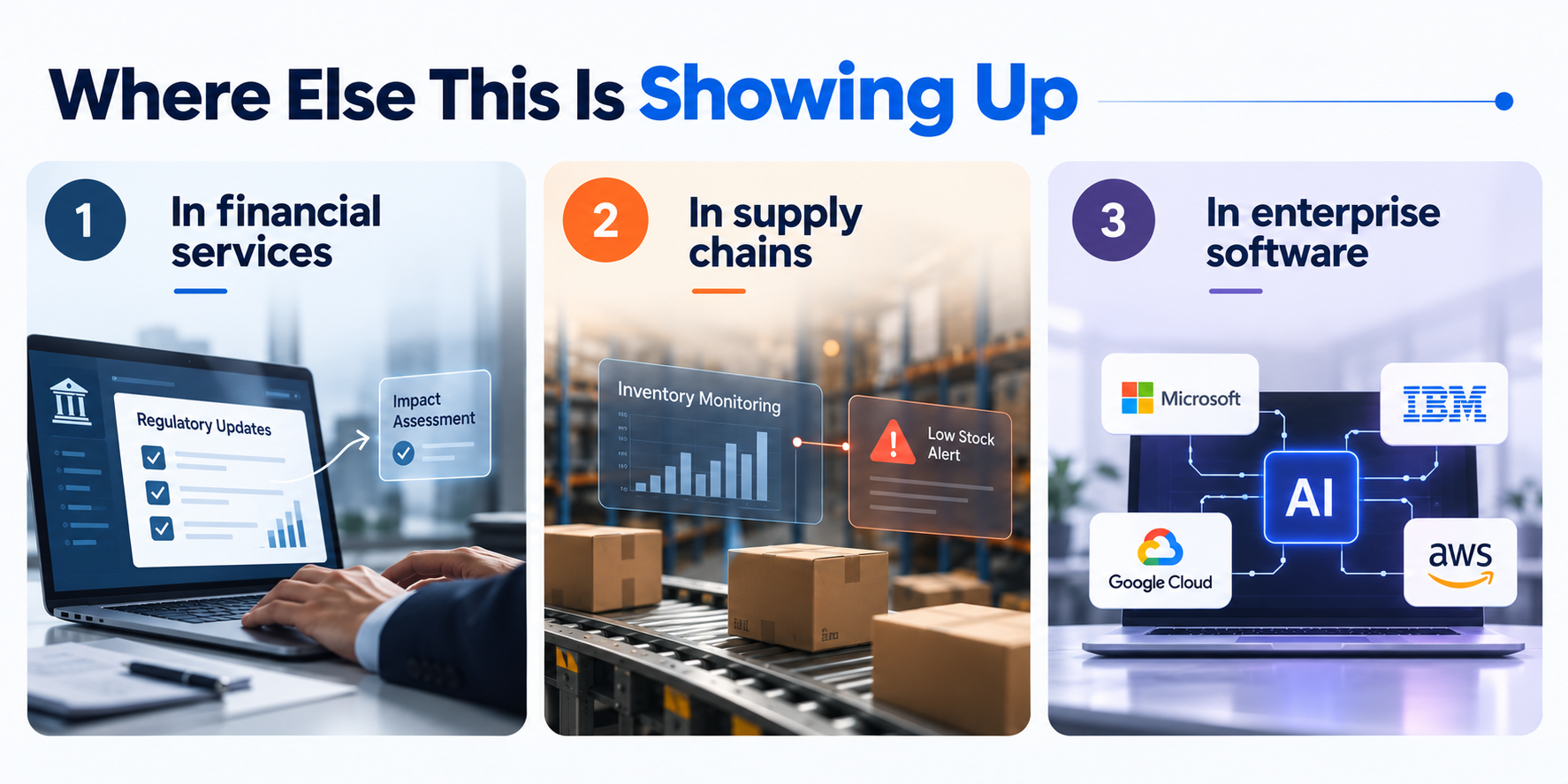
- In financial services, specialized AI systems are monitoring regulatory changes and preparing impact assessments automatically.
- In supply chains, AI agents are watching inventory and flagging problems in real time, rather than waiting for a weekly report.
- In enterprise software, major players, Microsoft, IBM, Google Cloud, AWS, are racing to build these connected decision systems into their platforms.
Why “Just Ask AI” Is Starting to Feel Limited
Asking a chatbot a question is genuinely useful, but it puts all the follow-through on you. You still have to gather the context, connect it to other information, and make the call yourself.
Decision intelligence flips that. The system already has the context, it’s already watching the relevant data. Instead of you asking a question and doing the legwork afterward, the system does more of that legwork continuously, and surfaces what actually matters when it matters.
That’s a meaningfully different relationship with AI, less like a search bar, more like a colleague who’s already looked into it, the way Walmart’s system doesn’t wait to be asked about weather and demand, it’s already watching both.
FAQs
Q1. Is decision intelligence the same as agentic AI?
They’re related but not identical. Agentic AI focuses on taking action, decision intelligence focuses on guiding the choice behind that action.
Q2. Does this mean AI is replacing human decision-making?
Not according to most experts, it’s positioned to support and speed up human decisions, not remove people from the process.
Q3. Which industries are adopting this fastest?
Retail, financial services, and supply chain operations are seeing the earliest real-world deployments.
Q4. Is this only for large enterprises?
Right now, most visible use cases are enterprise-scale, but smaller, task-specific versions are becoming more accessible.
Q5. What’s driving this shift technically?
Better multimodal AI models that can process different data types together, plus improved automation and orchestration tools.
To stay updated on the latest in digital technology and practical insights, visit Cleuz Blog and explore more resources for forward-looking development.