
Agentic AI Explained: Top Benefits of Getting Tasks Automated
Most people still think of AI as something you ask a question and it answers. Agentic AI works differently, and it’s quietly changing how businesses get things done.
Here’s what that actually means, and why it’s worth paying attention to right now.
What Is Agentic AI, Really?
Regular AI tools answer questions or generate content when you ask. Agentic AI goes further, it takes a goal, breaks it into steps, and executes those steps across different tools and systems with minimal human supervision.
Think of the difference between a calculator and an assistant. One waits for input every single time. The other figures out what needs doing and just does it.
By the end of 2026, roughly 40% of enterprise applications are expected to include task-specific AI agents built right in, up from under 5% just two years ago. That’s a fast shift, and it’s already happening in customer service, sales, and IT operations.
A Quick Look at How This Plays Out
Vodafone’s SuperTOBi is now live across every European market, resolving more than 70% of customer queries end to end, with no human involved, alongside an 8% point improvement in customer satisfaction scores. In Italy, where the assistant runs under the Fastweb + Vodafone brand, it now serves close to 9.5 million customers with an 82% resolution rate. That’s not a pilot anymore, it’s core infrastructure.
The bots don’t just answer questions, they resolve entire requests end to end, without escalating most of them to a human.
That’s the real shift agentic AI represents. Not a slightly smarter FAQ page, but a system that actually finishes the task, and one that started small before it scaled this far.
Top Benefits of Getting Tasks Automated
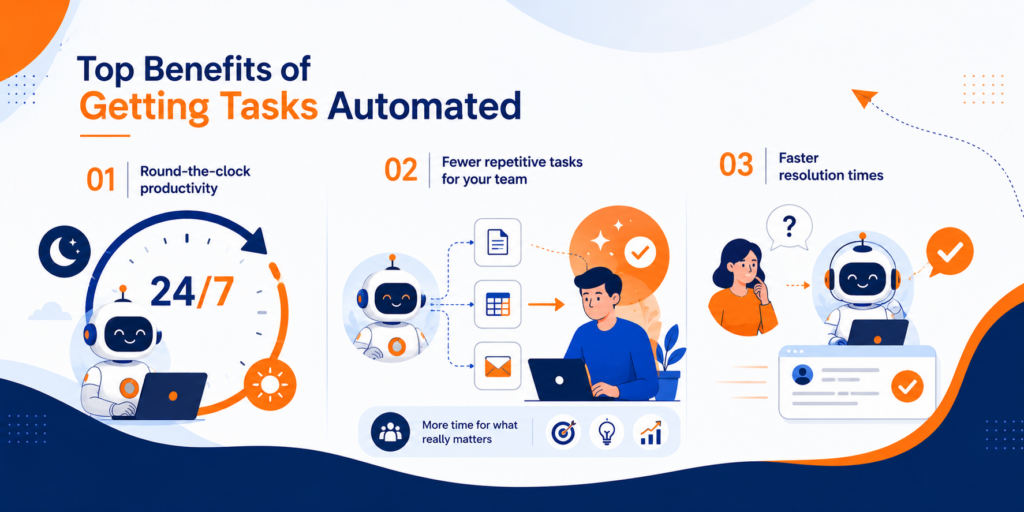
1. Round-the-clock productivity
Agents don’t clock out. Routine tasks, ticket sorting, data entry, follow-up emails, keep moving even outside business hours.
2. Fewer repetitive tasks for your team
Freeing employees from repetitive admin work means more time for judgment calls and actual problem-solving.
3. Faster resolution times
Customer service shows this clearest. Response speed and first-contact resolution both tend to improve once agents handle routine queries directly.
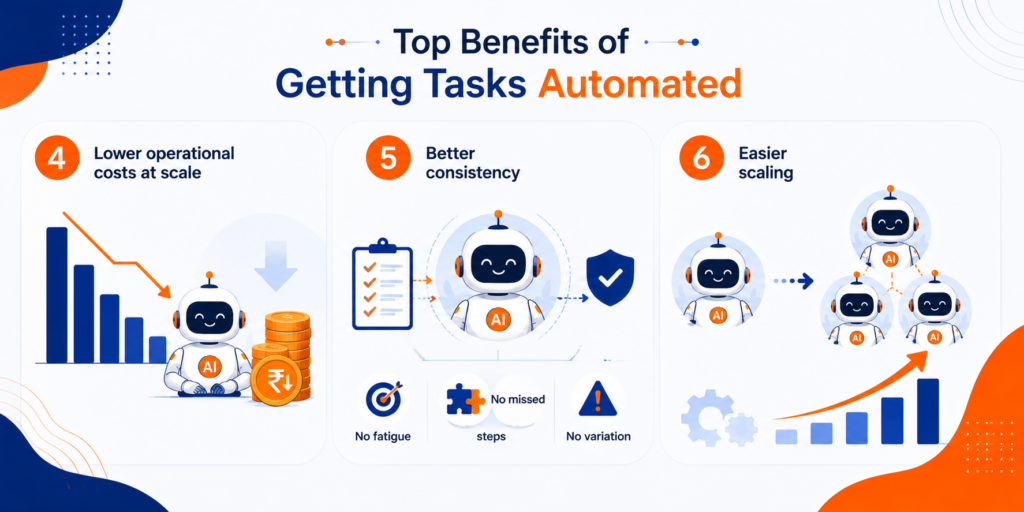
4. Lower operational costs at scale
Once a workflow runs reliably, cost per task drops sharply compared to manual handling, especially for high-volume processes.
5. Better consistency
Agents follow the same logic every time. No fatigue, no missed steps, no variation based on who’s handling it that day.
6. Easier scaling
Growing a manual process usually means hiring more people. Growing an agentic workflow often just means adjusting the system.
Where Businesses Are Already Using This
- Customer support, handling common queries end-to-end
- Sales, qualifying leads and scheduling follow-ups automatically
- IT operations, routing and resolving routine tickets
- Finance, flagging anomalies and processing standard approvals
- Education, answering admissions, fees, and timetable questions on school websites
Adoption vs. Real Results
| Stage | What It Looks Like | Where Most Companies Are |
|---|---|---|
| Experimenting | Testing agents on a small task | Around 62% of organizations |
| Piloting | One working use case, not scaled | About a third of companies |
| Scaling | Agents running reliably in production | Roughly 23% of organizations |
| Seeing real ROI | Measurable cost or revenue impact | Also around 23%, rarely without a clear plan |
The gap between trying agentic AI and actually benefiting from it is real. Vodafone didn’t start with 10 million monthly interactions, they started with one workflow that worked, then expanded it. That’s usually the difference between a project that stalls and one that scales.
Getting Started Without Overcomplicating It
Pick one repetitive, high-volume task, website queries are a common first choice, and build from there once it’s working reliably. Trying to automate everything at once is exactly why many agentic AI projects stall before delivering value.
If you’re weighing where agentic AI could actually fit into your business, Cleuz builds AI chatbots for educational institutions and banks that handle everyday website queries, admissions, fees, timetables, and account questions. Happy to talk through what that could look like.