
AI Is Now Shopping for Your Customers: Is Your Business Ready?
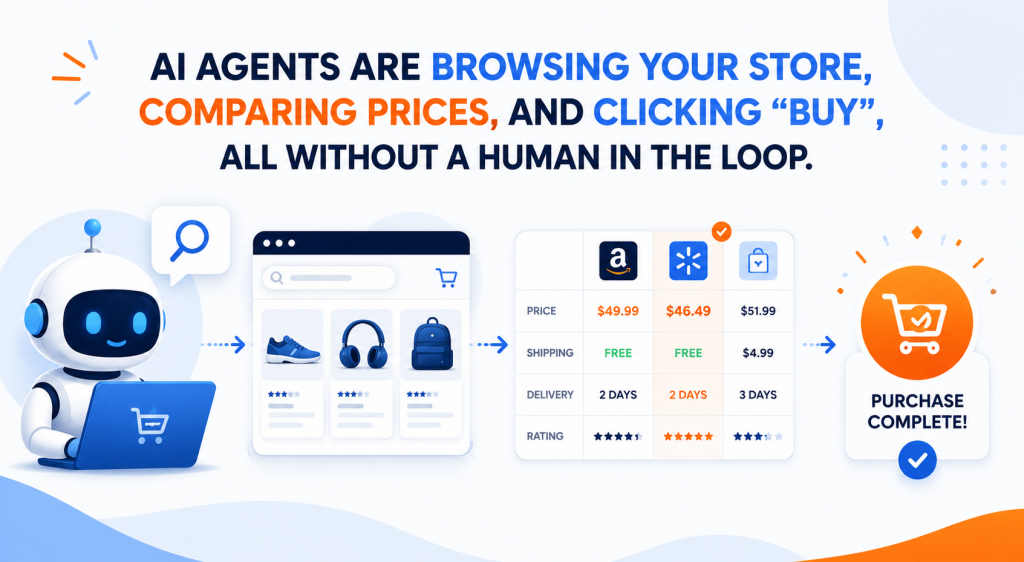
AI agents are browsing your store, comparing prices, and clicking “buy”, all without a human in the loop. Here’s what that means for your business.
Think about the last time you asked an AI assistant to find something — a flight, a product, a service. Now imagine it did not just find it. It went ahead and bought it. That is not some distant idea. It is already happening.
AI shopping agents now operate across retail, travel, and business procurement. They browse, compare, and purchase on a customer’s behalf. If your website is not ready for this, you are not just missing a trend. You are becoming invisible to a whole new kind of buyer.
What exactly is an AI shopping agent?
Think of it as a programme you give instructions to. You say “find me the best wireless headphones under ₹5,000 with same-day delivery” and it handles everything. It visits websites, reads product details, checks reviews, compares prices, and completes the purchase. No human clicks needed.
Big companies are already deep into this space. OpenAI built Operator. Google built Project Mariner. Amazon has Rufus. All three share the same goal, let AI take over the routine work of finding and buying things.
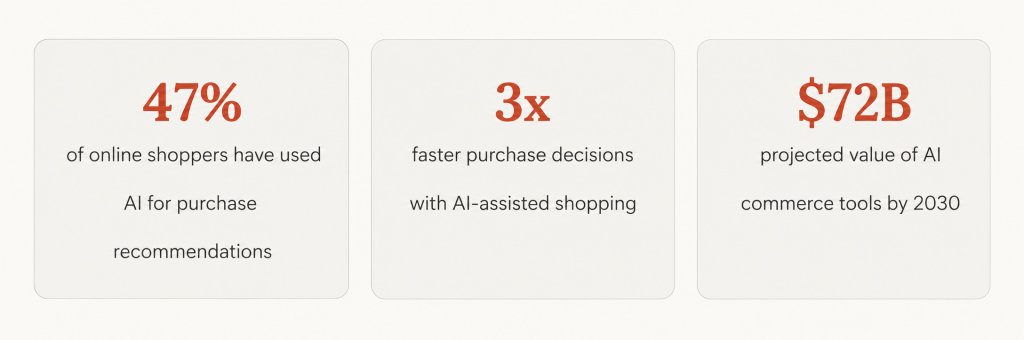
Why this is a big deal for sellers
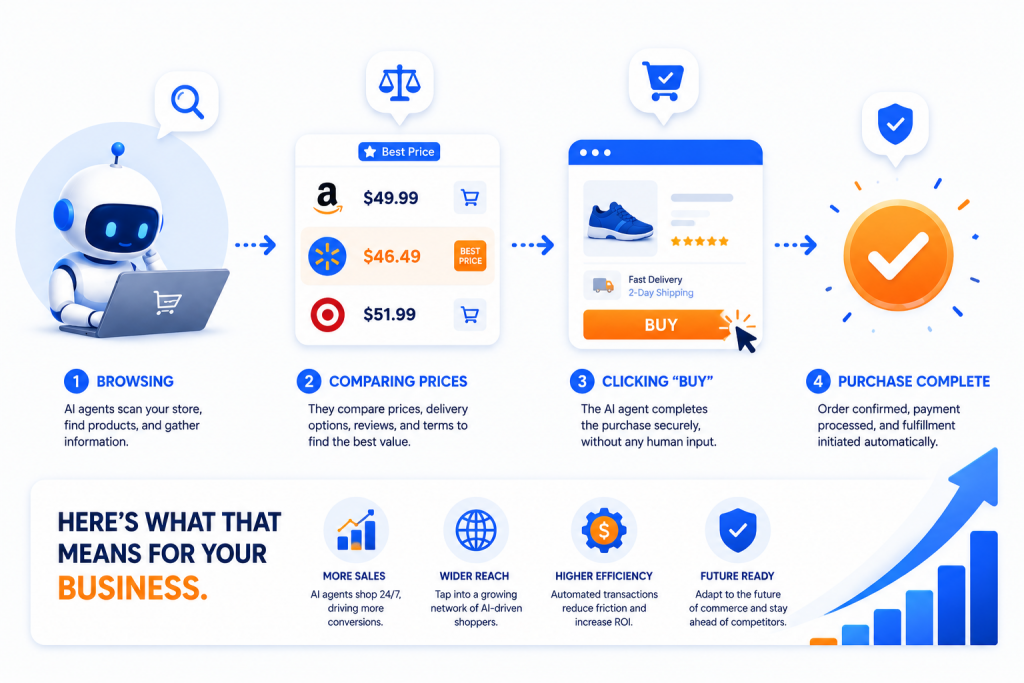
Online shopping always catered to human eyes — nice product photos, emotional writing, attractive branding. AI agents ignore all of that. They look for clean, readable data: price, availability, specifications, reviews, return policy, and page speed.
The real change: Earlier you sold to people who browsed with feeling. Now you also have to sell to software that browses with pure logic.
Vague product descriptions will push agents away. Missing technical markup will push agents away. A login wall before the price shows up? The agent leaves. It moves straight to a competitor whose website it can read properly.
What you should do straightaway
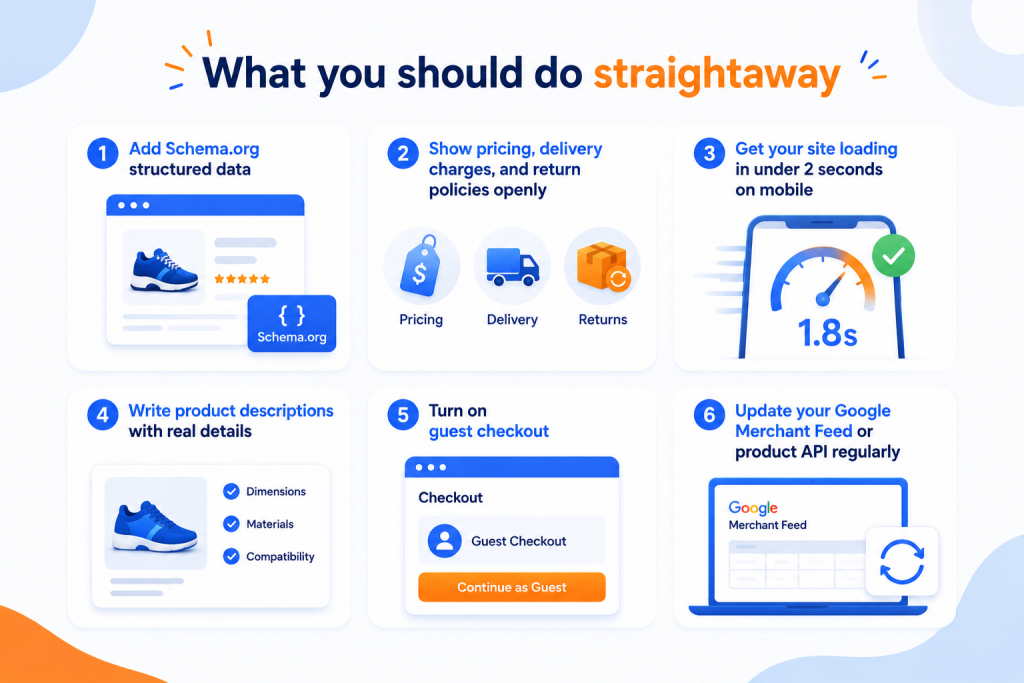
Here is the good part. Making your website ready for AI agents and making it better for regular customers is mostly the same work. Clean data, fast loading, and honest product details help everyone. Start here:
- Add Schema.org structured data to your product pages — this lets AI agents read your inventory correctly
- Show pricing, delivery charges, and return policies openly — visitors should not need to log in to see them
- Get your site loading in under two seconds on mobile — agents do not wait for slow pages
- Write product descriptions with real details — dimensions, materials, compatibility — not just marketing copy
- Turn on guest checkout — an AI agent cannot create an account on someone’s behalf
- Update your Google Merchant Feed or product API regularly — agents pull data directly from these sources
The trust factor and why it matters now
Here is something most business owners have not thought about yet. When an AI agent shops for someone, it works from a shortlist of stores it trusts. That list takes shape right now. Your reviews, your site’s credibility, your data quality, all of it feeds into that list.
Getting onto that shortlist in 2026 matters as much as ranking on Google’s first page mattered in 2010. Businesses that move early will build their place before these lists harden into habits.
This is not about worrying. It is about being prepared. More purchases, especially repeat ones and research-heavy ones, now go through automation. Make your business easy to find, easy to trust, and easy to buy from. That works for humans and AI agents a like.
To stay updated on the latest in digital technology and practical insights, visit Cleuz Blog and explore more resources for forward-looking development.