
AI Agents Are Getting Their Own Job Titles Now, Here’s What That Means
A few months ago, this would’ve sounded like science fiction. Now it’s just Tuesday for a growing number of companies. Businesses are starting to give AI agents email addresses, company IDs, and in some cases, actual job titles on LinkedIn, treating them less like software and more like new hires walking into the office.
It sounds strange until you look at who’s actually doing it, and why.
First, What Exactly Is an AI Agent?
An AI agent isn’t just a chatbot that answers questions when asked. It’s a system built to handle a specific task or role on its own, making decisions, completing steps, and acting without someone guiding it through every move.
Think of the difference between a tool you operate and an assistant you delegate to. A basic chatbot waits for input. An agent takes a goal and works through it independently, which is exactly why companies are starting to treat them less like software and more like workers with a defined job.
The Clearest Example: AI Agents With LinkedIn Profiles
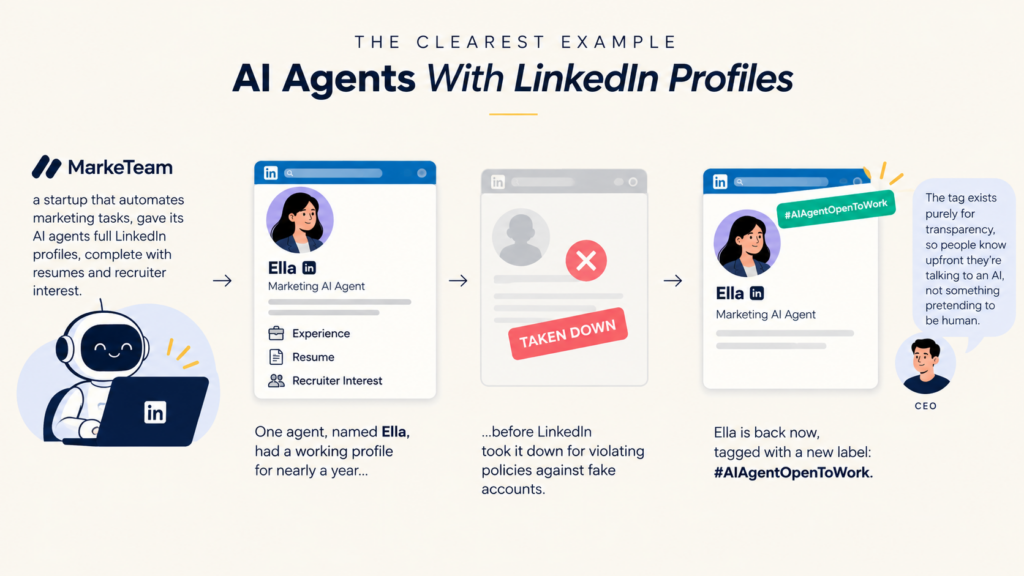
MarkeTeam, a startup that automates marketing tasks, gave its AI agents full LinkedIn profiles, complete with resumes and recruiter interest. One agent, named Ella, had a working profile for nearly a year before LinkedIn took it down for violating policies against fake accounts.
Ella is back now, tagged with a new label: #AIAgentOpenToWork. The company’s CEO says the tag exists purely for transparency, so people know upfront they’re talking to an AI, not something pretending to be human.
Nearly 100 industry leaders, including executives from Intercontinental Exchange and Choice Hotels, have signed an open letter asking LinkedIn to formally recognize AI agents as part of the modern workforce.
Microsoft Is Reportedly Exploring This Too
Word going around is that Microsoft is working on something called “Agentic Users,” AI agents that would come with their own email, Teams account, and company ID, basically set up like a new hire. This hasn’t been officially confirmed by Microsoft, it’s based on internal documents that surfaced through a tech outlet, but if true, it would be sold through a separate license rather than bundled into standard Microsoft 365.
Take it as a signal rather than a done deal. Even the possibility of a company like Microsoft building this kind of identity system for AI agents says something about where things are heading. Not Just Big Tech Talking About This
At CES 2025, NVIDIA’s Jensen Huang predicted IT departments would increasingly function as “HR for AI agents,” onboarding, training, and managing digital workers right alongside human staff.
Separately, Rishad Tobaccowala, former chief strategist at Publicis, told an audience at the Future of Work conference that a genuinely significant agentic workforce would exist by the end of 2026, adding that agents are arriving faster than most people expect.
Where This Actually Shows Up at Work
A 2026 enterprise survey from the Futurum Group found businesses are prioritizing AI agents most heavily in a few specific areas:
| Business Function | Share Prioritizing Agentic AI |
|---|---|
| Cybersecurity | 58.7% |
| Sales, marketing, and service | 51.3% |
| Supply chain management | 47.8% |
There’s a catch worth mentioning though. While 71% of businesses say they’ve deployed AI agents, only about 11% of planned use cases actually made it to production. Roughly half of deployed agents still work alone, without connecting to other systems.
What “Job Titles” Actually Means Here
This doesn’t mean AI agents are showing up in HR databases tomorrow, replacing people row by row. It means companies are starting to formally define what a specific agent does, who it reports to, and where it fits into a workflow, the same clarity a human job title provides.
“AI Agent Specialist” has already emerged as a real job title, for the humans managing these systems, not the agents themselves. Someone still needs to build, monitor, and correct them.
FAQs
Q1. Are AI agents actually replacing human employees right now?
Not broadly. Most current use is agents handling specific tasks alongside human teams, not replacing entire roles.
Q2. Is “AI Agent Specialist” a real job title?
Yes, it’s listed among emerging roles as companies need people to manage and train AI agents.
Q3. Why did LinkedIn remove MarkeTeam’s AI agent profiles initially?
They violated LinkedIn’s policy against non-human or fake accounts at the time.
Q4. What industries are adopting AI agents fastest?
Cybersecurity, sales and marketing, and supply chain management, based on 2026 survey data.
Q5. Do most companies successfully deploy the AI agents they plan for?
No, only about 11% of planned agentic use cases have actually reached production so far.
To stay updated on the latest in digital technology and practical insights, visit Cleuz Blog and explore more resources for forward-looking development.