
Small Language Models: The Quiet Shift Away from Giant AI
Picture a small Co-operative bank’s fraud team. Every day, they scan thousands of transaction alerts, most of them harmless, a few genuinely risky. They don’t need a giant AI model reasoning through poetry or history to do this. They need something fast, accurate, and that never sends customer data outside the building.
That’s the real story behind small language models, or SLMs. Not a downgrade from “big AI,” just AI finally matched to the job it’s actually doing.
So Why Did “Bigger Is Better” Stop Working?
Ask yourself this: does classifying a support ticket really need the same brainpower as writing a legal brief?
For a long time, the industry acted like it did. Everyone defaulted to the biggest model available, even for repetitive, narrow tasks, and paid premium API costs for it, query after query, month after month.
That math is falling apart now, for three practical reasons:
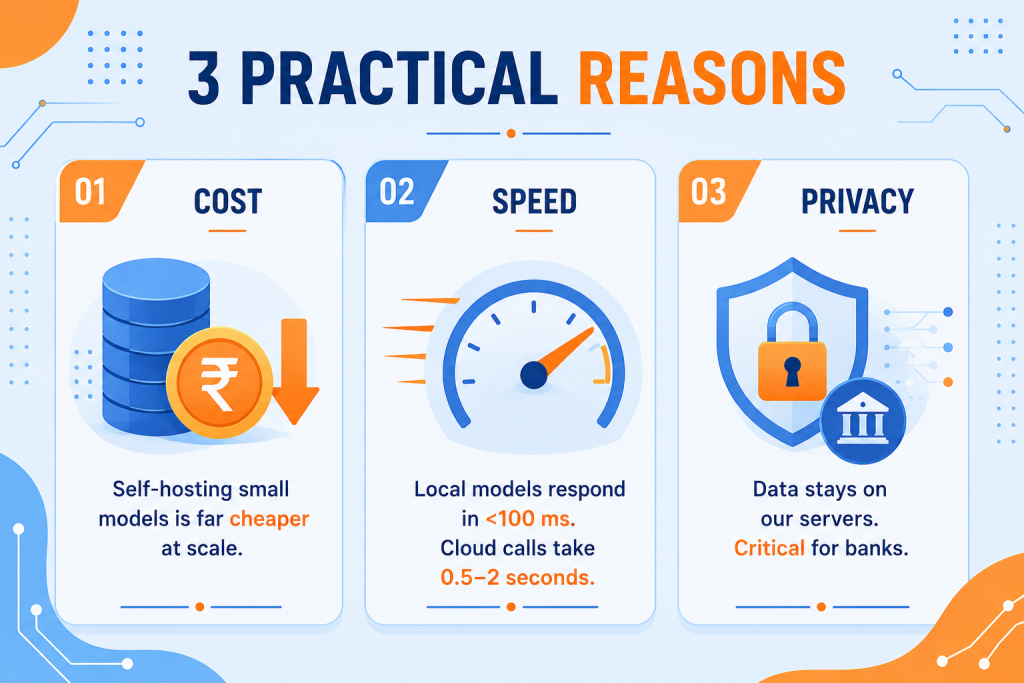
- Cost. Once a task runs millions of times a day, self-hosting a smaller model gets dramatically cheaper than paying per token to a cloud API. The savings compound fast at scale.
- Speed. A model running locally can respond in under 100 milliseconds. A cloud call often takes half a second to two, which is noticeable and frustrating in a live customer chat.
- Privacy. No data ever leaves the organization’s own servers. For a bank, that’s not a nice-to-have, it’s the whole point of the exercise.
What Does “Small” Actually Mean Here?
Nothing dramatic. Think a few million parameters up to around 7 billion, small enough to run on a single server, or even a laptop, instead of a sprawling cloud cluster.
The surprising part? These smaller models now hit 80 to 95 percent of the performance of much bigger ones on everyday tasks like classification, summarisation, and structured reasoning. The gap that used to justify “always go big” is closing fast, and for most business use cases, it’s already closed enough to matter.
Back to That Fraud Team
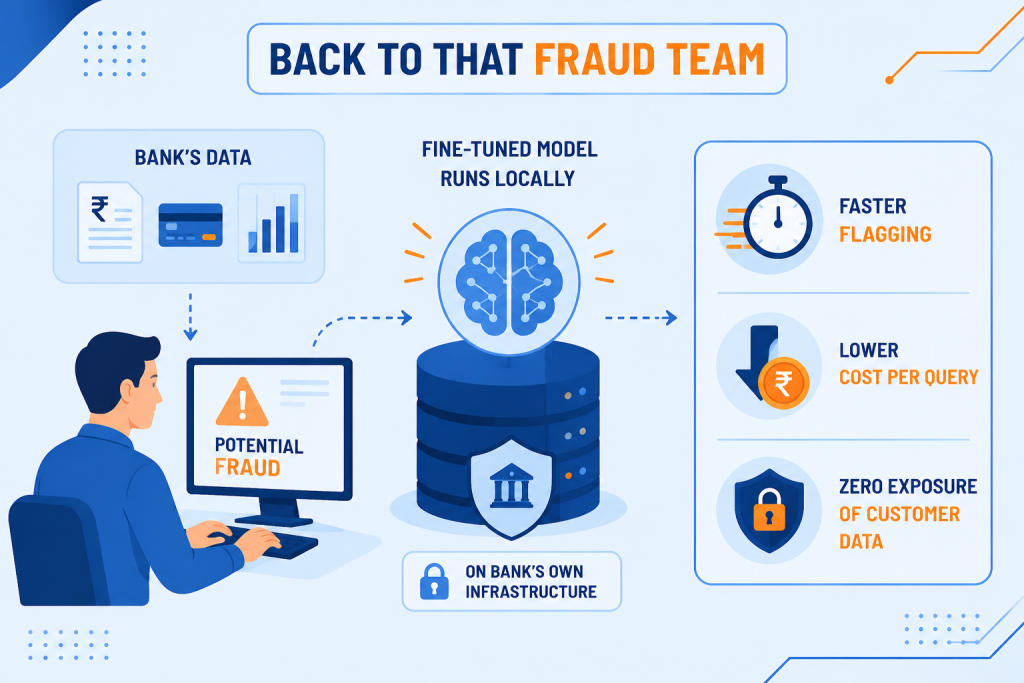
Say the bank fine-tunes a small model on its own historical transaction data and internal fraud patterns. It runs locally, on hardware the bank already owns, and never touches a third-party server.
The result: faster flagging, lower cost per query, and zero exposure of customer financial data to an outside API. That’s not a hypothetical. It’s exactly the pattern banks, hospitals, and law firms are adopting right now, largely because regulation leaves them little room to choose otherwise.
Where This Is Already Happening
- Fraud detection reading transaction logs and regulatory filings
- Legal teams scanning contracts for specific clauses
- Support desks routing tickets without human triage
- Meeting notes summarized without leaving the internal network
- Retail stores running voice ordering on local edge servers
SLM vs. LLM, Side by Side
Press on the blocks to know more:
Does This Mean Giant Models Are Done?
Not even close. Nobody’s asking a small model to write a novel or reason through an ambiguous legal dispute. Large models still own that territory, and probably will for a while.
What’s changing is the architecture around them. Most routine queries now get handled by a small model sitting close to the data, and only the genuinely hard ones get escalated upward to something bigger. Gartner expects enterprises to lean on task-specific models three times more than general LLMs by 2027.
That’s not a fringe prediction anymore. It’s already how banks like the one in our example are quietly rebuilding their AI stack, one workflow at a time.
FAQs
Q1. What’s a small language model, in plain terms?
A compact AI model, usually under 7 billion parameters, built to run on hardware you already own.
Q2. Do SLMs sacrifice accuracy?
Barely, for narrow tasks. Many now match 80–95% of larger models’ performance.
Q3. Why do banks specifically care about this?
Because it keeps customer data on-premises, which regulators increasingly demand.
Q4. Will SLMs replace large models completely?
No. Most organizations are running both, side by side, depending on the task.
Q5. Is it actually cheaper?
Yes, especially once query volume climbs, since there’s no per-token API bill.
Cleuz builds task-specific AI for Co-operative banks, the same way that fraud team above would. See how SmrtNxt keeps intelligence in-house, not in the cloud.