
AI’s Water Problem: Can Tech Growth and Sustainability Coexist?
Every time you generate an image or ask a chatbot a complex question, real-world resources get consumed. The AI boom is undeniably thirsty. So, this raises a critical question: can tech growth and sustainability coexist?
The short answer is yes. However, it requires a massive industry-wide shift. To balance innovation with environmental responsibility, tech giants must adopt advanced liquid cooling. Additionally, they need to utilize recycled water and build data centers with comprehensive regional planning in mind.
The Hidden Water Footprint of Artificial Intelligence
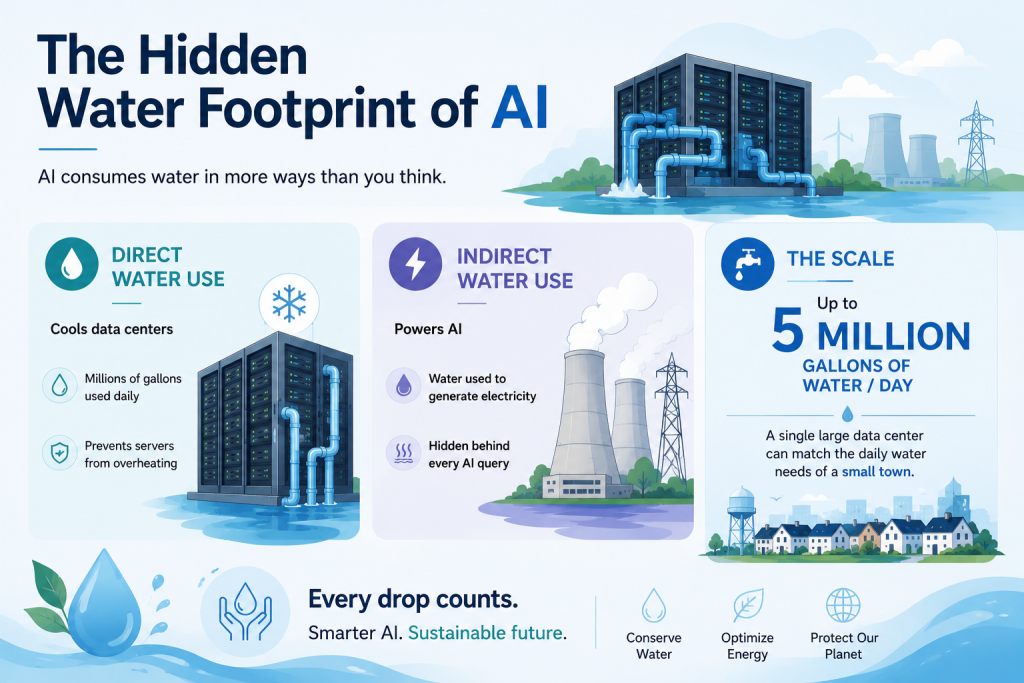
When we talk about AI’s environmental cost, carbon emissions usually steal the spotlight. Yet, water consumption is rapidly becoming an equally pressing crisis.
AI’s water footprint comes in two forms. First, direct water usage involves the millions of gallons used daily to cool overheated servers in massive data centers. Second, there is indirect water usage, which is the water evaporated during the electricity generation process required to power these facilities.
In fact, a single large data center can consume up to 5 million gallons of water a day. That’s the equivalent of a small town’s daily domestic needs.
When Data Centers Meet Local Communities
As companies scale their AI infrastructure, the strain on local resources intensifies. Consequently, communities globally are starting to face competition for clean water, pitting domestic needs against AI-driven data center operations.
In regions facing drought and water scarcity, adding a high-consumption data center can overwhelm aging local infrastructure. Therefore, the solution isn’t just about building bigger facilities. Instead, it’s about deploying them responsibly without draining local watersheds.
3 Ways to Make AI Water-Sustainable
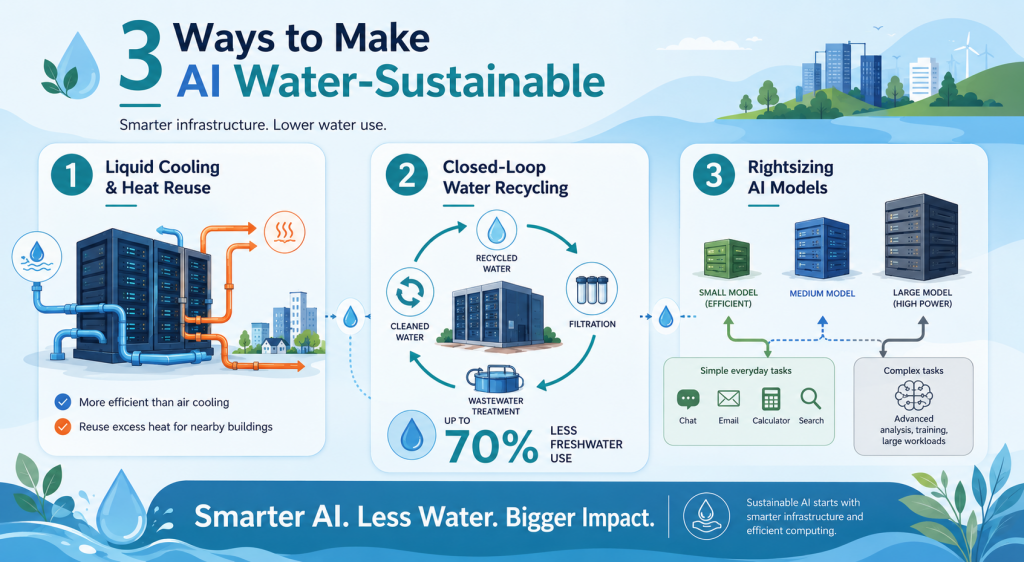
To ensure the digital economy doesn’t break the environment, the data center industry is implementing several promising solutions:
Liquid Cooling and Heat Reuse: Instead of traditional air blowing, new direct-to-chip liquid cooling systems are far more efficient. Plus, the captured heat can be recycled to warm nearby homes or businesses.
Water Recycling (Closed-Loop Systems): Similarly, modern facilities are shifting to municipal recycled water or closed-loop systems. As a result, this reduces freshwater dependency by up to 70%.
Rightsizing AI Models: Not every query requires a massive AI model. So, using smaller, task-specific models can dramatically cut computing power and water needs.
Comparing Data Center Cooling Methods
Here is a quick look at how traditional and modern cooling methods stack up:
| Cooling Method | Water Consumption | Energy Efficiency | Environmental Impact |
|---|---|---|---|
| Traditional Air Cooling | High (Relies on evaporation) | Low (Squanders energy) | Strains local freshwater supplies |
| Closed-Loop Systems | Low (Reuses same water) | Moderate to High | Protects community potable water |
| Direct Liquid Cooling | Very Low | Very High | Captures heat for potential reuse |
The Path Forward for Sustainable Tech
For AI to truly thrive, it cannot come at the expense of our planet’s most vital resource. Therefore, creating water-conscious infrastructure will require close collaboration among governments, utilities, and technology leaders.
Ultimately, by prioritizing transparency, efficient hardware, and renewable energy, we can enjoy the benefits of AI without drying up our future.
5 Quick FAQs on AI & Water Use
1. Why does AI need so much water?
AI requires massive computing power, which generates intense heat. As a result, water is primarily used in cooling towers to prevent data center servers from overheating.
2. How much water does a single chatbot prompt use?
While exact numbers vary, researchers estimate that a standard conversation with a large AI model can consume about a standard water bottle’s worth of freshwater.
3. What is “indirect” water usage in AI?
Indirect water usage refers to the water consumed and evaporated by the power plants generating the electricity needed to run AI data centers.
4. Are tech companies taking steps to reduce AI’s water consumption?
Yes. Specifically, major tech firms are investing in water replenishment projects, shifting to non-potable recycled water, and developing advanced liquid-cooling hardware.
5. Will AI water consumption cause water shortages?
If left unregulated, it could strain vulnerable regions. However, with proactive regional planning and closed-loop cooling innovations, severe shortages can be prevented.
Want to explore how sustainable technology can drive your business forward? Get in touch with Cleuz to discover innovative digital solutions built for a smarter, greener future.